Detroit's Dirty Deeds: The $100 Letter That Exposed Detroit's Solar Land Grab
How a “Good‑Faith Offer” two weeks before Christmas revealed a hidden plan to rezone our neighborhood, strip our rights, and turn District 3 into an industrial solar zone without community consent.
Detroit's Dirty Deeds
3/29/20263 min read
Two Weeks Before Christmas: The Letter from the City of Detroit That Changed Everything
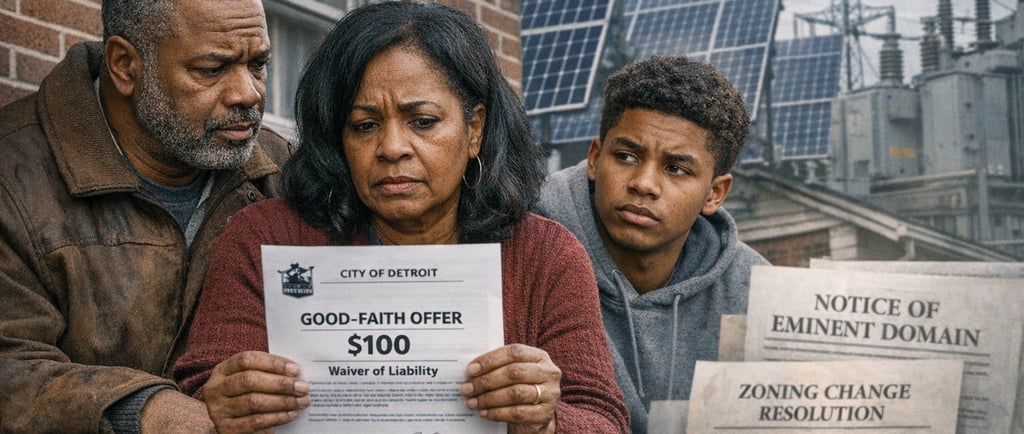
Two weeks before Christmas 2025, my family received a letter that would shake the foundation of our home a place we’ve lived in since 1971. The City of Detroit sent us what they called a “Good‑Faith Offer Letter.”
Inside was an offer of $100 in exchange for our use‑restriction rights, along with a requirement that we sign a waiver of liability for hazardous substances.
This was the first time we had ever heard of a solar farm development in our neighborhood.
No community meeting.
No outreach.
No notice.
Just a letter telling us to give up our rights.
That moment forced us to unravel a story we never asked to be part of a story of zoning changes, political power, corporate partnerships, and a clean‑energy agenda that seems to benefit everyone except the residents who have held these neighborhoods together for generations.
How Did This Happen? The Hidden Agenda Behind Chapter 50
As we dug deeper, we learned that the City had quietly amended Chapter 50 of the Detroit Ordinance Code the zoning laws to allow industrial‑grade solar infrastructure inside residential neighborhoods.
This wasn’t a small adjustment.
It was a strategic legal maneuver that allowed the City to:
Reclassify residential land as commercial or industrial
Use “public necessity” to justify taking property
Invoke condemnation law (eminent domain)
Partner with DTE Energy to build utility‑scale solar farms
In other words, the City used its legislative power to rewrite the rules, its authority as landowner to assemble property, and its role as developer to push the project forward.
One entity playing three roles — with no independent oversight.
What This Means for Our Home
If this project moves forward, our family home the one my mother built and maintained for 54 year would sit next to what is essentially an energy power plant.
Here’s what that looks like:
• 20‑foot‑high solar arrays
Mounted on steel structures, towering over homes, casting shadows, and creating blinding glare for drivers and residents.
• Industrial‑grade inverters
These convert DC to AC power and generate constant noise, heat, and electromagnetic frequencies.
• High‑voltage transformers
Raising voltage from 600 to 1,500 volts or higher, producing vibrations and hums.
• Circuit breakers, switchgear, and substations
All operating day and night, producing 65+ decibels of noise — the sound of a lawnmower running nonstop.
• Potential battery energy storage systems
Which carry risks of fire, chemical release, and explosion.
This is not “clean energy” when placed in the middle of a neighborhood.
This is industrial infrastructure and Detroit is placing it next to people’s homes.
Why Would the City Do This?
The City claims this is about:
Remedying blight
Addressing low‑income status
Bringing opportunity to underserved neighborhoods
But let’s ask the real questions.
Does a solar farm restore dignity, safety, or stability?
No. It removes residents, removes rights, and removes protections.
Does it reduce the high energy burden Detroiters have carried for decades?
No. The energy produced powers 127 municipal buildings, not residents’ homes.
Does it create living‑wage jobs?
No. Solar construction jobs are temporary, and long‑term jobs are minimal.
Does it grow household wealth?
No. Homeowners are pressured into lowball buyouts or $100 easement waivers.
So what is driving this?
Follow the Money: The Inflation Reduction Act
The Inflation Reduction Act of 2022 allocated $389 billion for clean‑energy initiatives, with bonus incentives for projects located in:
Low‑income neighborhoods
Blighted areas
High‑unemployment census tracts
Detroit’s District 3 checks every box.
That means:
The City gets federal incentives
DTE gets tax credits and long‑term revenue
Developers get guaranteed returns
And residents?
We get displacement, industrial noise, environmental risk, and the loss of our rights.
The law was meant to uplift communities like ours not use our poverty as a financial opportunity.
So We Ask Again: Who Benefits?
Because from where we stand:
The law doesn’t benefit us
The zoning changes don’t protect us
The development doesn’t include us
The energy doesn’t power us
The money doesn’t reach us
This is not clean energy.
This is not community development.
This is not justice.
This is a land strategy, wrapped in green language, executed through legal loopholes, and funded by federal dollars meant to help not harm low‑income communities.
And it began with a letter two weeks before Christmas: $100 for our rights, or the City would take them through “Condemnation Law.” Fourteen days to choose between silence and survival.
Detroiters deserve clean energy without displacement, development without deception, and investment without exploitation. If this story resonates with you, share it. Talk to your neighbors.
Attend council meetings. Ask questions. Demand transparency. Our homes, our rights, and our future depend on it!