Detroit's Dirty Deeds: How Detroit Is Using Eminent Domain to Push Solar Farms Into Residential Neighborhoods
How a Clean‑Energy Agenda Became a Tool for Taking Land From the Communities It Claims to Help
3/30/20263 min read
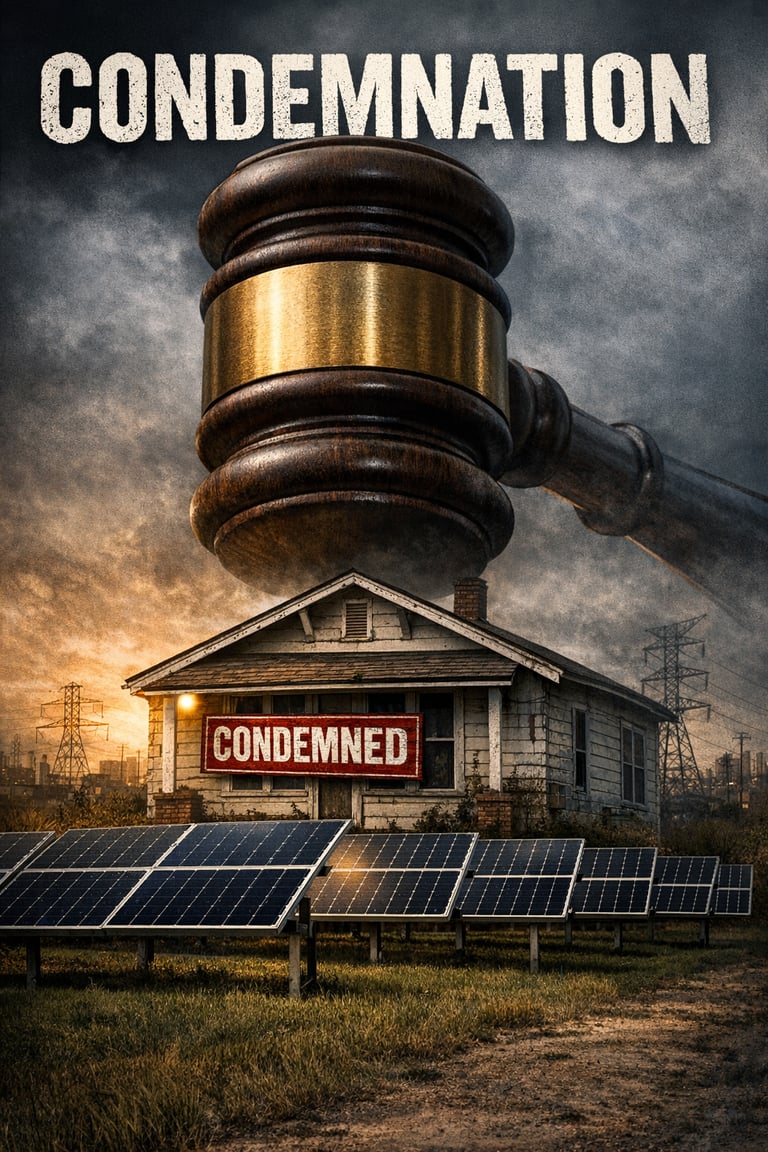
Eminent Domain in Detroit: How a Clean‑Energy Agenda Became a Tool for Taking Land From the Communities It Claims to Help
Detroit has a long memory when it comes to land loss.
Black Bottom. Paradise Valley. Poletown. I‑375.
Each time, the story was the same:
A public project. A promise of progress. A neighborhood erased.
Today, the same machinery is running again only this time, it’s wrapped in buzz words like “clean energy,” “sustainability,” and “public necessity.”
And once again, it is Detroit’s low‑income, majority‑Black neighborhoods that are being targeted.
This is the new green displacement.
1. How Condemnation Law Works — and How It’s Being Used
Condemnation law, also known as eminent domain, allows the government to take private property for a “public use” but only if it provides just compensation.
Traditionally, this meant:
• Highways
• Schools
• Public utilities
• Transit lines
But Detroit is now using condemnation law to take:
• Use‑restriction rights
• Easements
• Access rights
• Residential land for industrial solar farms
And instead of “just compensation,” families are being offered $100 backed by the threat of court action if they refuse.
This is not how eminent domain was meant to function.
This is coercion disguised as policy.
2. How “Public Necessity” Is Being Stretched Beyond Recognition
To use condemnation law, the City must prove the project is a public necessity.
But here’s the truth:
The solar farms do not power residents’ homes.
They power 127 municipal buildings.
The energy does not reduce Detroiters’ bills.
Residents still face some of the highest energy burdens in the nation.
The project does not restore neighborhoods.
It industrializes them.
The public does not benefit — the City and DTE do.
Calling this a “public necessity” is a legal stretch so wide it breaks the spirit of the law.
3. How Zoning Changes Create the Conditions for Takings
The City didn’t start with eminent domain.
It started with zoning.
By amending Chapter 50 of the Detroit Ordinance Code, the City:
• Reclassified residential land
• Created special exemptions for solar infrastructure
• Removed barriers to industrial development
• Reduced community oversight
• Paved the way for condemnation
Once the zoning changed, the City could argue:
The zoning change manufactured the justification for the taking.
This is how policy becomes a weapon.
4. Detroit’s History of Land Taking — Now wrapped in Clean Energy Initiative
Detroit has seen this pattern before:
Black Bottom & Paradise Valley
Destroyed for “urban renewal.”
Poletown-4,200 residents displaced for a GM plant justified as “economic development.”
I‑375-A freeway carved through a thriving Black community.
Each time:
• The project was framed as progress
• The community was sacrificed
• The benefits flowed upward
• The harm stayed local
Today’s solar‑farm expansion follows the same blueprint -- only now the justification is “clean energy.”
The language changed.
The outcome did not.
5. Why $100 Easement Waivers Are Legally Dangerous
The City’s “Good‑Faith Offer” letters are not harmless.
They ask residents to:
• Give up use‑restriction rights
• Sign liability waivers for hazardous substances
• Accept $100 as compensation
• Allow industrial equipment near their homes
• Waive future claims
This is not a negotiation.
It is a legal trap.
Once a homeowner signs:
• They lose leverage
• They lose rights
• They lose legal standing
• They cannot challenge environmental harm
• They cannot fight future expansion
A $100 waiver can cost a family generations of protection.
6. How Residents Can Fight Back
Detroiters are not powerless. Here are the tools communities can use:
• Demand full environmental review
Solar farms with industrial equipment require impact studies.
• Challenge the “public necessity” claim
If the public does not directly benefit, the justification collapses.
• Expose the zoning manipulation
Show how Chapter 50 was amended to enable takings.
• Organize residents to refuse easement waivers
If enough people refuse, the project stalls.
• Document every communication
Letters, calls, notices everything matters in court.
• Build public pressure
Media, social platforms, and community meetings shift political cost.
• Demand transparency on IRA funding
If federal dollars are being used to harm low‑income communities, that is a violation of the spirit of the law.
Detroit has always fought back and won...when residents stand together!
Conclusion: Clean Energy Should Not Cost People Their Homes
Solar energy is not the enemy. Displacement is.
Clean energy should uplift communities, not uproot them. It should reduce burdens, not create new ones. It should heal neighborhoods, not hollow them out. Detroit deserves a green future, but not one built on the backs of the very people it claims to help.
This is not sustainability. This is not justice. This is the clean energy displacement.
And Detroiters have the right and the responsibility to call it what it is.
Attend council meetings. Ask questions. Demand transparency. Our homes, our rights, and our future depend on it!